


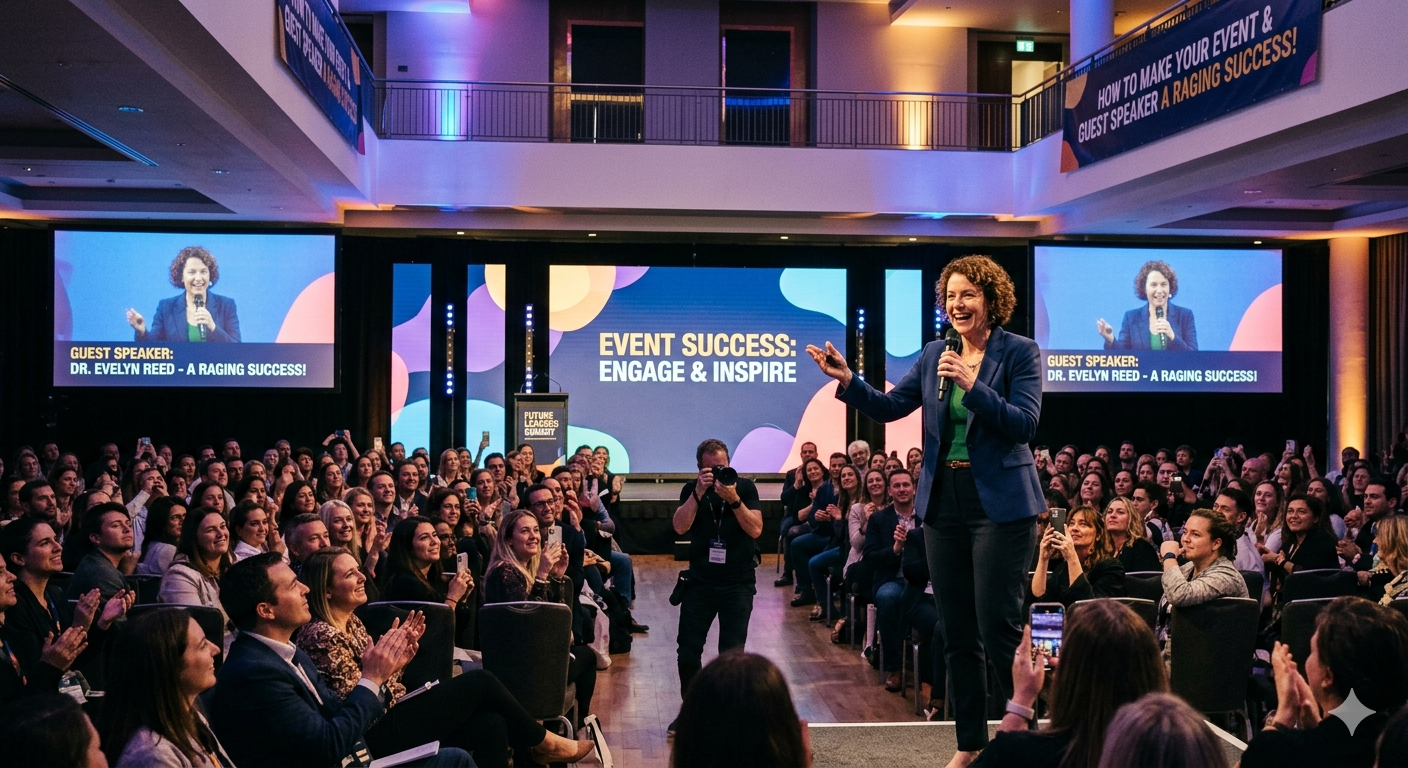
Weeks and months of planning go into putting on an event.
You’ve only got one chance – the event is either a success or a failure.
So you will want to do everything in your power
Having spoken about 50 times a year for the last decade at various seminars, conferences, retreats and corporate trainings, I can say I have seen my fair share of successes and failures.
No doubt you have too if you have been involved in booking speakers or organising events for any length of time.
You can do all the preparation in the world and your event can still be a flop … and usually it is down to things that could have been avoided.
For example, the speaker or speakers you booked were ‘self-involved’, only really interested in ‘their’ speech, and caring little about your overall event goals or keeping to time.
It may be the biggest downer on the day when you get a speaker who runs over time, blows out the schedule, and makes everything else late. It upsets everything and all that is remembered is that nothing ran on time and the attendees were ‘peeved’.
Another disaster is booking a ‘boring’ speaker who puts everyone to sleep. There’s nothing worse than seeing your attendees reaching for their phones to check messages in the middle of a presentation!!! This is not to mention them joking about the bad speaker who put everyone to sleep for years to come.
If you really want to run the best event possible, you just need to do a little extra work in advance to make sure that you get the best possible speaker(s). They are the focal point of your entire event – they get the blame if it goes wrong and are the heroes if it goes right.
With that in mind, based on my years of experience, I’ve outlined the 5 Key Things you need to do to ensure you get the ideal speaker or speakers for your next event.
Step 1. Know EXACTLY WHAT YOU WANT
It is easier to find what you are looking for when you know what it is. Stephen Covey’s principle ‘Start with the end in mind’ certainly applies to planning events.
Before contacting a speaker’s bureau or a speaker directly, answer these questions along with any other event organisers.
i) What is the exact topic/content/outcome we want?
Do you need someone to motivate your attendees and set the tone for the event? Are you looking for someone to improve sales, people’s health or ramp up productivity and workplace effectiveness?
If you don’t know what you want, then any speaker will do.
ii) What style or type of speaker do we want?
Broadly speaking there are three speaker types you can choose from:-
- A speaker high in CONTENT (rich in take-home information)
- One high in INSPIRATION (motivating people to take action)
- One high in ENTERTAINMENT or FUN (giving everyone a good laugh)
The best speakers and the one you probably want is one who can combine all three.
In this day and age I will say that regardless of the inspiration and the take home information you need a speaker who is able to connect with an audience and be entertaining regardless of the subject matter they are covering.
Veteran event organisers will be nodding their head in agreement at this. The audience’s attention span is getting shorter – due to smart phones, internet, on-demand TV and more…
Speakers can’t just be dispensers of information. They need to inspire and entertain. An entertaining speaker with less content will be better appreciated by an audience than a know it all who is boring.
In your audience’s mind there is nothing worse than being put to sleep in their seats and feel that their precious time is being wasted … and they are the ones filling out the feedback cards at the end of the day!
iii) Are we happy with just a ‘1-3 hour talk’ or should we look for a speaker who provides after-the-event resources/support?
Most speaker seekers tend to only think about getting the best speaker for the 45 minutes or 2 hours allocated for ‘the guest speaker’ timeslot. However, this has major limitations. If results and a return on investment from the event are important to you, then you can massively increase the results you and your team receive by choosing a speaker who also provides ‘ongoing support and post-event resources.’
For example, I routinely speak about how maintaining a real-world work-life balance, can substantially boost individuals productivity, as well as the health, wellbeing and morale of the entire workplace.
Burn out is one of the most common reasons many people leave their jobs and is really just a symptom of a lack of work-life balance, or proper motivation.
HR professionals tell us that they budget 150% of a workers income to cover for the loss in productivity and to hire and train a replacement. So for someone on $100,000 a year, that’s a $150,000 cost to the company if they get burnt out and leave.
So just cutting staff turnover by 10% can be a huge saving.
The point is, while in one or two hours I can show attendees a number of simple, immediately implementable ways to enjoy better health, motivation, productivity & work-life balance (so they can be home in time for dinner), we all know that seminar attendees forget 80-90% of what they learned within 48 hours of hearing a speaker.
That means we need a resources to embed the teachings in order for you to see a greater return on your speaking investment. And keep receiving that return long after the event has finished.
To make sure I do this I offer loads of additional resources, unlimited ongoing support and even make a structured 12 month follow-up email course available. Though almost no other speakers do, I also happily offer a range of resources ‘before’ the event to help organisers maximise audience interest and attendance and help attendees start making changes prior to the event.
As you can see, getting a speaker who does something similar to this will provide a far greater ROI than a speaker who just turns up, entertains or inspires for an hour or two and then leaves. So make this a key consideration.
* Tip: If you are not sure what type of post-event support is possible or most appropriate for your group, in addition to asking speakers you are considering booking, also try asking a Professional Speaker you are NOT going to book (so they are unbiased), or a Speaker’s Bureau.
Step 2. Decide on Your Preferred PRESENTER TYPE
Do you want an expert, an entertainer or a celebrity?
If you want ‘high interest’, or to get people ‘in the door’, go for the entertainer or celebrity.
If you want practical take-home value, go for the expert – you will get twice the information for half the cost.
As a rule of thumb the when there are multiple speakers at events you’ll see there is a mixture of experts, entertainers and/or celebrities. This way there is useful information and at the same time plenty of entertainment so that the audience doesn’t get overwhelmed or bored and stay engaged through the whole event.
Regardless of speaker type, choose a speaker who is at least reasonably engaging/entertaining/humorous. Audiences secretly want to be entertained more than anything. So don’t get a speaker who puts them to sleep in their seats.
Having a speaker ‘bomb’ hurts you and your business. You may never hear the end of it from your colleagues and that’s just for a start.
In the grand scheme of things you’ve also got to consider – the audience want to come back again. They may have to come back. But while they show up they may have switched off and aren’t going to do much more than occupy a seat. They may also just sneak off home early or be found in the bar or otherwise socialising during event time.
Whoever is sponsoring/funding the event wants see a good ROI on the event. Getting Professor Boring McDuff up to speak and sucking the life out of the audience is the fastest way to kill the return on all your hard work and money.
No speaker is going to tell you they are boring. You know what will fly with your audience and no speaker is everyone’s cup of tea. Do yourself a favour and try and see a speaker you are interested in live in advance of selecting them.
Step 3. Determine your BUDGET – Before You Start Looking!
Knowing your budget (at least approximately) is critical, as it will save you loads of time & hassle looking in all the wrong places. Don’t worry, there are plenty of speakers for all budgets and I’ll tell you the best places to find good speakers for each budget.
For now determine your ‘ballpark’ budget (ask the final decision-maker if you need to).
i) Under $3000
ii) $3,000 – $5000
iii) $5,000 – $10,000+
* When budgeting, factor in whether the speaker will simply do a ‘one-off’ talk – never to be seen again – or provide some sort of follow-up/ongoing assistance. The real value for you is in the ongoing support post event.
Step 4. Select The Right Speaker For Your Event And Your Goals
It sounds obvious, but like any profession, you have professionals you can bank on and others who can wreck your whole event – they run over their allocated time, they are boring… putting attendees asleep in their seats. Sleeping pills are a much cheaper way to do this. Unfortunately they aren’t always faster.
Use the following checklist to ensure your speaker is a professional you can have ‘peace of mind’ with before you contact them.
i) Quickly check how long a speaker has been speaking. Nothing beats experience. You know experienced speakers should be competent, but more importantly they already know how to prepare and deal with adversity. They show up early to walk the room. And know how to handle ‘unforseen technical difficulties.’
They know the show must go on and can make that happen.
ii) Are they accredited? Accreditation is not common in Australia, so certainly don’t discount a speaker who isn’t accredited. If they are though, see it as a big mark of confidence. It usually ensures a high level of both proficiency and professionalism.
iii) See if you can see if the speaker has experience speaking to your specific audience. If you can’t tell, be sure to ask them if you decide to contact them.
iv) Dig Deeper Than attendee TESTIMONIALS. Checking testimonials is a good general way to see how others have found a speaker. Look for testimonials not just from participants, but from previous function/conference organisers.
Ideally, you not only want a good speaker but someone who is accommodating, flexible & can help your overall event. A good speaker will have these on display too. If not, then be sure to ask them for event organiser testimonials.
If the speaker doesn’t have any, as part of your due diligence, try asking the speaker if you can speak directly to one or two of their recent clients. Just gauging their response will be good feedback. If they hesitate or give excuses, they might be hiding something. If they are happy for you to do so, you probably don’t even need to proceed.
Step 5. Start Contacting
Okay, good work. You know exactly the type of speaker you are looking for and how much you want to spend.
So before you go reaching out I bet you’d like to know the best questions you can ask a speaker so you can be sure that you genuinely going to get a speaker that not only makes your event a success but also delivers real ongoing value.
1. Will you deliver a message in alignment with my event’s goals/theme?
Many times speakers get hired under the assumption that they will do their homework and research the company and the industry before they get on stage. Like many children, speakers won’t do their homework unless they have to. I personally pride myself on being prepared and being on target with my message.
But I like to make it easier on myself too. So I get help from the event organisers. This is why once I am booked I always do a pre-event phone call to discuss areas of opportunity for the audience and how we can address them within the theme of the event.
Great speakers always match their message to the audience.
You know your audience better than I do, so I get the event organiser to share with me who is in the audience. What went well in the past and what didn’t go so well and why? So that we don’t ‘repeat the sins of our fathers.’
2. Can you supply me Pre-event resources/content?
A well prepared speaker has a variety of resources that you can use to generate excitement about the event or get people to register and attend.
I’m fairly well known. I’m not necessarily a name in every household but I have been speaking 25-50 times a year for some 10 years. I’ve written a best selling book. I’m famous in my neck of the woods.
However, if an attendee hasn’t heard of me then they are going to google me. They will want to see if what I have to say is relevant and of value to them and what others have said about me.
You can cut this off at the knees. That way, you get to frame why they should come to the event and be excited about it rather than Google. (Google doesn’t consider the success of your event important the way you do.)
A speaker who has prepared content and resources for you to use in assisting promotion is a great asset. That way you can drip content to your attendees to help them get in the right mood for the event.
The speaker should be able to provide some or all of the following
- Attendee testimonials (bonus if they have video testimonials)
- Blog/Facebook posts
- Book excerpts
- Articles archives or past editions of their newsletter
- Webinar/tele-seminar either pre event (generate excitement) or post event (Q & A perhaps)
- List of Endorsements/Awards/recognition re-enforcing the speaker’s relevance and value
- Press releases
- Assistance making themselves relevant to your event and audience
- The speakers bio and program one-sheet
3. What Post Event Resources Can You Offer?
I’ve mentioned the why of this before. If you are just after a speaker to provide 45 minutes of filler this question doesn’t matter. However, if you really want value for your investment in a speaker you need post event support/resources.
Event attendees will forget 80-90% of the content of a talk within 48 hours. So if you want the speaker’s message to stick and be a source of on-going improvement and change then you need ‘take home goodies’ for the attendees.
These might include
- A real book or ebook
- Some sort of course to reinforce teachings and make them stick. Such as an email course, home study kits etc
- White papers or reports
- C.D. or mp3 (or both) of the talk
- Post-event tele-seminar or webinar for Q & A
- Content you can use in post event communications
- Resource list mentioned in the talk
- How to reach the speaker via Social Media
Finally I would ask “Can I come and see you live?”
Nothing beats the live experience. That is the best indication you can get of what the speaker will deliver on the day at your event. That’s why I offer everyone who enquires about booking me a ‘guest ticket’ to come and see me live. You may not be able to see the program you want me to present for you but at least you get a taste of what I am like ‘for real.’
Also this is your chance to pay close attention to how respectful they are with times. A speaker who runs over time will blow out your event schedule. For the audience, nothing beats being held back and missing your morning tea because the speaker can’t finish within their allotted time.
One final thing before I move on.
When you are talking to the speaker be very aware of how much they talk about you and your event vs how much they talk about themselves. The speaker is not the event, they are a critical part of the event – but the event as a whole has to be a success not just the time an individial speaker is on stage.
Now let’s show you the best places to go for the speaker you want.
Since you’ve read this far, you have probably seriously considered booking me. So here’s what I recommend you do next:
Arrange to have a meeting with me and my team – so we can go over your event, discuss all the details and most importantly determine if we are good fit for each other – and we can work out the best opportunities for you to redeem your ‘See Mark Live’ ticket you got with this report. That way you’ll have the best idea possible what I can deliver for you.
However, I don’t accept every client and I am not everyone’s cup of tea.
At the end of the meeting if you want to proceed, we’ll get the agreements in place and put together a timeline so that we can do everything in our collective powers to make your event a roaring success.
Like I said, I’m not everyone’s cup of tea. That’s life, so here are some of your other options should either of us decide this isn’t going to work out.
1. You want ‘The Best’: Your Budget is $5,000 +
Okay, easy one. Go straight to a Speakers Bureau. See ‘Contacts’ below.
At this price, most speakers get booked through a bureau anyway, so go straight there. You don’t pay anything for the service (they take a fee from the speaker) and you get the best possible speaker suggestions. As the top speakers are with all the leading bureaus, there is no promoting their ‘own’ speaker, so it’s unbiased.
Tips when using Bureau’s:
i) Ask to receive some ‘1 sheets’ (bureau talk) on 3, 4 or 5 speakers, not just 1 or 2. Then ‘you’ can choose, rather than just going on their suggestion.
ii) If you have questions/need help with your general event/conference
organisation etc, just ask them. They can be a great all-round resource.
2. You want a Quality Speaker: Your Budget is $3000 – $5000
At this level, speaker’s bureaus are still a good (low hassle) option, but I think it can work really well to also try contacting some speakers direct – especially if you want extra value for your money. You see, it’s pretty competitive at this budget range, by contacting some speakers directly, they are more likely to add in some extras (books, videos, consultations, prizes, some follow-up, free e-zines etc etc) to give you much more pluck for your buck. They may still want you to book them through a bureau (which is fine), but you’ve got yourself some handy extras.
Where Else Do I Find $3,000 – $5,000 speakers?
Good question. It’s a little tricky, but for this range I would start with Search Engines (more details at bottom). Search for whatever type of speaker(s) you are after – conference speaker, keynote speaker, sales speaker, female guest speaker, etc.
If a speaker is listed high on a search engine or advertises, and when you go to their site, it is predominantly a ‘speaker’ site (i.e. not a consultant or someone who just speaks ‘on the side’), then you can be pretty sure you’re dealing with a ‘professional’ speaker…and therefore in this fee range (or higher).
Some speakers list their fees on their site, most don’t. Contact the ones you like the sound of and ask not only what their fees are, but ALSO, what you get for that fee. There is no obligation and never any harm in asking.
The National Speakers Association (NSAA) can also be good. On their site (below), you can look up speakers under different states & topics. If they have an ASM, APS or CSP accreditation (CSP being the highest), they will be good quality speakers you can depend on.
3. You would like a ‘quality’ speaker but your Budget is Less than $3,000
* May apply if you are a non-profit, educational or ‘small’ business type group.
Step 1 – Don’t despair!! While in Australia professional speakers generally start at around the $3,000 mark, don’t think you have to go and ask the janitor to speak just yet. Understand that not all speakers are just about making money. There are some creative ways you can still get a top speaker.
Step 2: Get some creative strategies.
Strategy 1:
If you are involved with a charity, a community type group, some other ‘good cause’ group or even just a ‘small’ budget corporate group, I would still approach the top speakers. i.e. as a special request. Obviously, if the speaker feels it is a worthy cause, or you can offer some other incentive (see below), some will do it to help out.
At Health Advantage Australia, we personally have a set program, where we offer a Reduced Fee Talk for ‘special groups’ once a month. It can be great, because it’s often your type of groups that are the most rewarding to work with (& appreciative), and I know other professional speakers that feel the same way. So again, just ask (put your case), if they say no, you’ve lost nothing.
Strategy 2 – Give Alternative Incentives:
This is where you want to target the speakers that are good (their set fee is $3000+), but are not yet fully booked or booked regularly with bureaus.
Unless you genuinely have a restricted/low budget, it’s better not to ask for a reduced fee, as it’s not fair (unless you are a ‘special case’), for speakers to give a talk at one price for one group and another price for another.
Note: I would advise NOT contacting bureaus at this level. They are in business to promote their paid speakers. It’s not really fair on them (or up to them) to consider special rate talks. It’s best to approach speakers directly at this level.
If you are genuine though, you basically find the speaker(s) you most like (from Search engines, checking out their website etc) and offer them alternative incentives.
As these speakers are in the process of ‘building their businesses, offer them things that can help do that and you’ll get a much better response. You can help an up and coming speaker by:
1) Writing them a (good) testimonial (if you genuinely like/value their talk).
2) Referring them on to others group you know – particularly larger/corporate groups you have contacts with etc.
3) Let them sell their products if they have them – books, tapes, coaching sessions etc.
4) Guarantee ‘multiple talks’ – i.e. with other divisions of your group, or book a talk every 3 months for a year, etc. This way although the fee per talk is less, they benefit from guaranteed future talks.
5) Have their talk ‘professionally videotaped’ or have professional photos taken. This one can work really well. For professional speakers, having quality photos / a video of them presenting is ‘promotional gold’. However, many just don’t seem to get around to it, don’t have time etc.
By offering to do it for them, (it will only cost you a few hundred dollars and a bit of organisation time), and you could get a top speaker for peanuts.
Contacts / Where to Look
Speakers Bureaus:
I won’t recommend individual bureaus. All are good and work much the same.
i) Look in Yellow Pages under ‘Speakers’.
ii) Search for ‘Speakers Bureaus’ in search engines.
Most bureau websites are good places to visit as you can see a range of speakers in the topic you are after. Some even give a fee range for each speaker, allowing you to compare who you like with what fits your budget.
Search Engines:
Good for contacting individual speakers. Be as ‘specific’ as possible.
E.g. ‘motivational’ keynote speaker not just keynote speaker, ‘Brisbane’ sales speaker, ‘female’ keynote speaker if you want a female etc.
Professional Speaking Associations:
National Speaker’s Association:
This gives a good list of professional speakers, topic by topic. Also lists an
Accreditation level – ASM, APS, CSP – so you can see how
experienced a certain speaker is. See
Last Straw – You Still Can’t Find Someone Suitable?
If you’re still unable to find a suitable speaker, I am happy for you to contact me. Simply let me know what type of speaker you are after, budget, etc and if I can, I will be happy to give you some suggestions/recommendations based on speakers I know / have seen etc.
If easier, send details via
Good luck. I hope your event is a spectacular success.
Mark Bunn
About The Author:
Mark Bunn is the head of Work-Life Success Seminars, is a best selling author and professional speaker whoo has presented in multiple countries for well over a decade.
In an earlier life (the 1990′s), Mark was an AFL Footballer for 6 years, playing alongside greats such as Paul Roos, Dermot Brereton, Jason Dunstall, Shane Crawford and Alistair Lynch.
It was the experience of maintaining peak physical health and along with utilising peak performance principles that has fueled Mark’s success in the business world.
Mark is the author of ‘The Year Round Health & Work-Life Success’ Program and now combines training in health science with his time working with elite athletes and senior personnel from companies such as CBA, Macquarie Bank, PMM, Citigroup & Merrill Lynch to show busy businesspeople how to get the job done and achieve great success while getting the balance right and looking after No.1.
Mark’s research shows that we Australians spend more time at work than any other nation. Concerned about the growing difficulties of Australian workers to enjoy a healthy work-life balance, Mark studied the universal productivity, time-management and success strategies of the world’s most effective businesspeople.
He uses these insights to help people structure their work and life that allows for ongoing results while maintaining personal balance.
Mark is the author of ‘Healthy People, Healthy Business’, ‘The Year Round Health & Wellbeing Program’ and the best-selling ‘Ancient Wisdom for Modern Health’ – the simple secrets of the world’s healthiest people. The first in a 3 book ‘Wisdoms of Health’ series, ‘Ancient Wisdom’ is now published in 7 countries, and has seen Mark featured in media throughout Australia & India.
Mark has been featured on:
- Richard Stubbs Show (ABC Melbourne)
- Denis Walter Show (3AW Melb)
- Dr Ross Walker and George & Paul Shows(2UE Syd)
- The Glenn Wheeler Show with Susie Elelman (2GB Syd)
- ABC Adelaide & Darwin
- Margaret Throsby & The Spirit of Things Programs (ABC)
Mark’s feature articles have also appeared in magazines such as ‘Wellbeing’, ‘Australian Natural Health’, ‘Australian Yoga Life’ & ‘Management Today’.
Mark is a former resource presenter for The Executive Connection – an International Group of CEO’s, and Duke Corporate Education (USA) – a global training company. He presents to around 10,000 people a year throughout Australia and New Zealand, and is now considered a ‘first-choice’ speaker in the areas of health & wellbeing, personal performance, work-life balance and motivation.
Mark supports the Beyond Blue national depression initiative, the ‘Look Good, Feel Better’ Program for Cancer Patients and the David Lynch Foundation
For any questions or speaker recommendations etc, feel free to contact Mark anytime.
Ph: +61 411 183 625
E: info@markbtest.dharmicliving.com
This article is fully copyrighted. Copyright © 2004 Health Advantage Australia.
All rights reserved. Please do not copy or reproduce any part of this article without permission.